Anatomy learning app: Best apps in 2026 (3D atlas, quizzes & flashcards)
Looking for the best anatomy learning app in 2026? This guide compares top 3D anatomy atlas apps, quiz tools, and flashcard systems. Includes a practical checklist, a 14‑day study plan, and how to combine active recall, spaced repetition, and okti to remember anatomy long-term.
Anatomy learning app: Best apps in 2026 (3D atlas, quizzes & flashcards)
Anatomy can feel endless: hundreds of structures, unfamiliar names, relationships in 3D space—and then the exam expects you to identify, name, and explain everything quickly.
A great anatomy learning app can cut your study time dramatically, but only if you pick tools that match your goal. Because “anatomy app” can mean three completely different things—and that mismatch is why many students waste hours scrolling without improving recall:
- 3D atlas / visualization (to understand spatial relationships)
- Quizzes & labeling tests (to practice retrieval under pressure)
- Flashcards & spaced repetition (to remember long-term)
This guide gives you a practical comparison, a decision checklist, and a study plan you can actually follow. It’s absolutely doable with the right system.
Table of contents
- Quick answer: which anatomy learning app is best?
- Types of anatomy apps (and what they’re good for)
- Checklist: what to look for in an anatomy app
- Quick comparison: top options (2026)
- Best 3D anatomy atlas apps
- Best quiz apps & testing tools
- Flashcards & spaced repetition (the missing piece)
- Common mistakes (and how to fix them)
- Feature breakdown: what “good” looks like
- 14‑day anatomy study plan (template)
- FAQ
- Conclusion
Quick answer: which anatomy learning app is best?
If you want the honest, useful answer: it’s rarely just one app. The best results usually come from a stack:
- 3D atlas to understand
- quizzes to test retrieval
- spaced repetition to keep it
If you only use a beautiful atlas, you may feel confident—but still fail at naming structures on demand. If you only do quizzes, you may lack spatial understanding. If you only do flashcards, you may miss 3D relationships.
The goal is to move from recognition (“I’ve seen it”) to recall (“I can produce it”). New to these methods? Start with our guides to active recall and spaced repetition.
Turn anatomy content into real reviews
With okti you can turn your lecture notes and PDFs into compact Q&A flashcards and review them with spaced repetition.
try okti for freeTypes of anatomy apps (and what they’re good for)
1) 3D atlas / visualization apps
Best for:
- spatial relationships (what’s anterior/posterior, superficial/deep)
- muscle layers, origins/insertions
- nerves and vessels as pathways
Typical weakness:
- passive learning (watching, rotating, zooming) is not the same as retrieval.
2) Quiz & labeling apps
Best for:
- active recall (naming structures without prompts)
- exam-style pressure (timed tests)
- identifying weak spots quickly
Typical weakness:
- question banks may not match your course exactly.
3) Flashcards & spaced repetition tools
Best for:
- long-term retention of terms, functions, relationships
- daily short reviews (10–20 minutes)
- building exam confidence through repeated retrieval
Typical weakness:
- creating good cards takes effort unless you have a workflow.
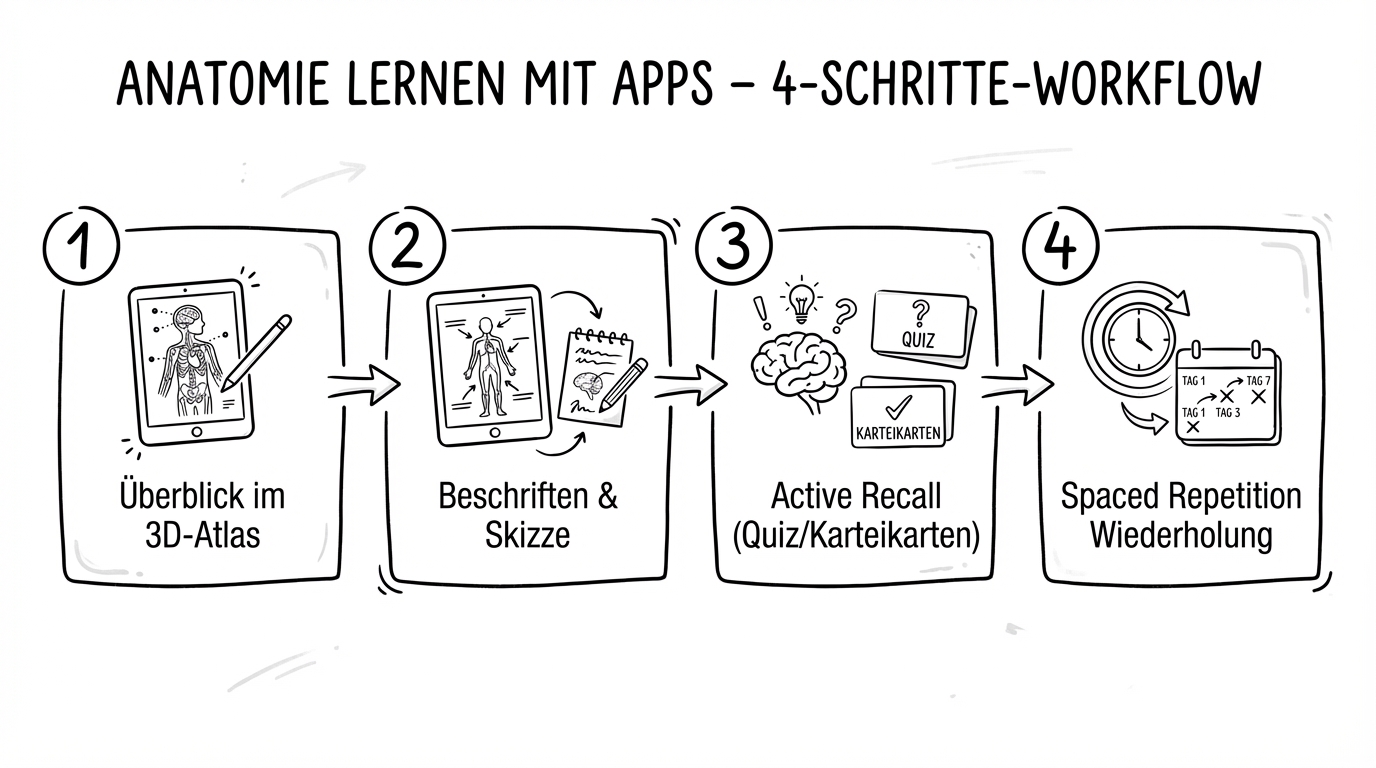
Caption: The most efficient order: understand → retrieve → repeat. Most students do it backwards.
Checklist: what to look for in an anatomy app
A) Does it match your program and level?
- medicine vs. nursing vs. physiotherapy vs. sports science
- do you need neuroanatomy depth? histology? clinical correlations?
B) Can it support active recall?
Look for:
- labeling tests (tap a structure, type the name)
- free-text answers (not only multiple choice)
- error lists (track what you miss)
You don’t learn anatomy by looking at it—you learn it by retrieving it.
C) Does it help you keep knowledge (spaced repetition)?
Many apps stop at “content delivery.” But anatomy requires long-term scheduling. Ideal options include:
- built-in review plans
- export/share features
- or a clean flashcard workflow
D) Language & terminology
- English/Latin/German naming
- consistency (Terminologia Anatomica style)
- pronunciation can be a bonus
E) Daily usability (underrated)
- offline mode
- fast search
- favorites and lists
- good tablet experience
Quick comparison: top options (2026)
| Tool | 3D atlas | Quizzes | Spaced repetition | Custom notes |
|---|---|---|---|---|
| oktiEmpfohlen | No | Yes | Yes | Yes |
| Complete Anatomy | Yes | Yes | No | Yes |
| Visible Body | Yes | Yes | No | No |
| Essential Anatomy | Yes | No | No | No |
| Course platforms (e.g., Kenhub) | No | Yes | No | No |
| Flashcard tools (e.g., Anki) | No | Yes | Yes | Yes |
Note: features vary by platform and subscription tier. Use this as a fast filter.
Pricing overview (typical models)
Anatomy apps usually fall into three pricing models. Exact prices change often (discounts, student plans, platform differences), so treat this as a map.
- One-time purchase
- Pros: predictable, often cheaper long-term
- Cons: sometimes fewer updates or limited content expansions
- Subscription (monthly/yearly)
- Pros: full feature set, continuous updates, often includes quizzes and courses
- Cons: can get expensive across multiple semesters
- Freemium
- Pros: you can try the UX and content quality
- Cons: key content (regions, test modes, offline access) is often paywalled
If you’re studying for a short block (2–4 weeks), a subscription can be fine. If you’ll need anatomy for multiple semesters, a one-time atlas + a flashcard workflow is often better value.
Recommended setups (depending on your goal)
To make this actionable, here are three setups that work well in real life.
Setup A: “I need 3D understanding for lab/dissection”
- 3D atlas app (your primary tool)
- short daily labeling quizzes
- flashcards for nerves/vessels/muscles you keep mixing up
Setup B: “I’m close to the exam and need naming speed”
- quizzes first (labeling + mixed review)
- flashcards daily (spaced repetition)
- atlas only when you get stuck on relationships
Setup C: “I want long-term retention without cramming”
- flashcards as your backbone (daily 10–20 minutes)
- atlas as reference (5–10 minutes when needed)
- weekly quiz session for pressure testing
Make your own course content reviewable
Instead of relying only on generic question banks, use okti to turn your lecture PDFs and notes into short Q&A cards and keep them with spaced repetition.
start with oktiBest 3D anatomy atlas apps
Complete Anatomy
Strengths
- excellent 3D detail and layering
- strong for relationships and pathways
- often used in medical education settings
Weaknesses
- can be expensive (subscription model is common)
- lots of features can feel overwhelming
Best for If you need a serious 3D atlas and you’ll use it consistently (e.g., during lab or dissection courses).
Visible Body (Human Anatomy Atlas)
Strengths
- strong visualization and navigation
- often a smooth experience on tablets
- good system-based exploration
Weaknesses
- can push you into “browsing mode” if you don’t pair it with tests
Best for If you want a well-structured atlas and you’re committed to active recall separately.
Essential Anatomy
Strengths
- lighter, often simpler than full suites
- great as a quick reference
Weaknesses
- typically less training-focused
Best for If you already have question sets and need visual support rather than a full learning platform.
Atlas apps make recognition easy. Exams require recall. Always follow atlas time with a short quiz or flashcard block.
Best quiz apps & testing tools
Anatomy becomes exam-safe through repeated retrieval. That’s why quiz-style tools matter.
What to look for
- labeling (structure → name)
- mixed review mode (randomization)
- weak-area lists
- short sessions you can do daily
Course platforms (as a category)
Many students use structured platforms that combine explanations and quizzes.
Pros
- guided chapters and progression
- often good mnemonics and clinical notes
Cons
- may not match your course perfectly
- subscription cost
- 8 minutes: atlas (understand the region)
- 10 minutes: labeling quiz (retrieve names)
- 7 minutes: flashcards (repeat weak spots)
Doing this daily beats a 3‑hour weekend session.
Flashcards & spaced repetition (the missing piece)
If anatomy keeps “leaking out of your brain,” you’re not broken—you’re normal. The fix is scheduling.
Spaced repetition means you review information right before you’d forget it. That turns short sessions into long-term memory.
Why flashcards work so well for anatomy
Anatomy naturally fits Q&A:
- “Which nerve innervates …?”
- “Origin / insertion / function of …?”
- “What passes through …?”
- “Which artery continues as …?”
The pain point: making cards takes time
So you need a workflow that’s fast and consistent. If your material is in lecture PDFs, you can also generate the cards from the PDF with AI instead of typing them.
A practical approach:
- after each lab/lecture, write 20–40 core questions (not 200)
- keep cards atomic (one fact per card)
- add images only where spatial context is critical
- review daily (10–20 minutes)
Example flashcards (simple but effective)
-
Q: “Main elbow extensor?” A: “Triceps brachii.”
-
Q: “Where does the ulnar nerve run at the elbow (common ‘funny bone’ spot)?” A: “Posterior to the medial epicondyle (ulnar groove).”
-
Q: “Biceps brachii: key actions?” A: “Elbow flexion + forearm supination.”
In okti, generated cards keep a “View source” link to the exact page of your PDF, and an Explain button breaks the answer down in simple words when a structure won’t stick. You can also speak your answers and get AI feedback — good practice for naming structures out loud, like in an oral exam or lab test. And if you keep missing the same card, okti’s Tutor mode offers to explain the topic in a short lesson.
Build better anatomy flashcards faster
Use okti to turn your PDFs and notes into compact Q&A cards and review them with spaced repetition—perfect for anatomy facts.
start with oktiCommon mistakes and how to fix them
Mistake 1: Staying in recognition mode
You recognize structures in the atlas but can’t name them in an exam.
Fix: end every session with 5–10 retrieval questions.
Mistake 2: Going too detailed too early
You lose days on tiny branches before you can name the big structures.
Fix: learn in zoom levels: overview → main structures → details.
Mistake 3: No review habit
Weekend marathons feel productive but collapse under exam pressure.
Fix: daily 10–20 minutes of spaced repetition (see also our anti-cramming tips).
Mistake 4: Flashcards without context
Single-word cards (“Femoral artery”) don’t train retrieval.
Fix: write cards as real questions with anchors (region, relationship, function).
Feature breakdown: what “good” looks like
When you compare apps, use this list as your decision framework.
Must-haves
- fast search with synonyms
- favorites/lists (e.g., “exam relevant”)
- some form of testing (quizzes or self-check)
- offline access
Nice-to-haves
- layer controls (skin → muscles → vessels/nerves)
- cross-sections (helpful for imaging)
- pronunciation
- notes attached to structures
The “sketch hack” (high ROI)
You don’t need art skills. A 60‑second schematic sketch with arrows and 3–5 labels forces active retrieval. It also improves spatial memory.
To level this up, add self-explanation: After the sketch, talk through it in one minute:
- “This structure is medial to …”
- “This nerve passes under …”
- “If this gets damaged, you’d expect …”
If you can explain it simply, you can usually retrieve it in an exam.
14‑day anatomy study plan (template)
This template is designed to be realistic. Adjust the regions to your syllabus.
Rules
- every day: one new topic + one review block
- retrieval beats rereading
- short daily reviews beat long sessions
Days 1–4: foundations
- Day 1: orientation, planes, basic terms
- Day 2: joints & movements
- Day 3: major muscle groups
- Day 4: overview of vessels and nerves
Days 5–10: regional anatomy (exam-focused)
- Day 5: shoulder/upper arm
- Day 6: forearm/hand
- Day 7: hip/thigh
- Day 8: leg/foot
- Day 9: thorax
- Day 10: abdomen
Days 11–14: practice and consolidation
- Day 11: two quiz sessions + error list
- Day 12: weaknesses only (hardest 30 cards)
- Day 13: mixed review mode (random)
- Day 14: light review + sleep
- 10–20 min: flashcard review (spaced repetition)
- 20–30 min: atlas + notes (understand)
- 15–30 min: active recall (quiz + your own questions)
FAQ
Is there a free anatomy learning app?
There are free options and freemium tiers, but the most useful features (full regions, tests, offline access) are often paid. If budget is tight, focus on a strong retrieval workflow (quizzes + spaced repetition).
Is a 3D atlas worth it?
Yes—if you use it actively:
- name structures out loud
- explain relationships
- immediately follow with quizzes Otherwise it becomes passive browsing.
Can I learn anatomy only on my phone?
You can learn the basics. Many students prefer a tablet/laptop for clarity and multitasking. And real lab time (models, specimens) should complement app practice.
What’s the fastest way to learn anatomy with apps?
Fast means efficient:
- understand briefly
- test immediately
- repeat regularly
Conclusion
A good anatomy learning app won’t magically teach you anatomy. But the right combination of tools can move you from “I’ve seen this” to “I can recall this under exam conditions.”
If you take one idea from this guide:
- use a 3D atlas to understand
- use quizzes to practice retrieval
- use spaced repetition to keep it
If you want to build exam-ready flashcards from your own course material, okti is designed for that. Start small: pick one region, create 30 high-quality questions, and review for 7–10 days. Track what you miss, rewrite weak cards, and you’ll feel your naming speed improve almost daily. The confidence jump is real.
Make anatomy exam-ready
Turn your anatomy notes into compact Q&A cards and review them with spaced repetition—using okti.
try okti