Learn the Feynman Technique: Step-by-Step Method, Examples, Common Mistakes & a 7-Day Plan
The Feynman technique is one of the fastest ways to truly understand what you study. Learn the 4 steps, see practical examples, avoid common mistakes, and combine it with active recall + spaced repetition (with a workflow that works great with okti).
Learn the Feynman Technique: Step-by-Step Method, Examples, Common Mistakes & a 7-Day Plan

You’ve probably had this happen: You read a chapter, watch a lecture, maybe highlight a few lines — and it feels like you understand it.
Then someone asks: “Can you explain it in one minute?”
And suddenly, your brain produces jargon fragments and half-sentences.
That’s exactly what the Feynman technique is designed to fix. It’s a simple (but demanding) learning protocol built around one brutal truth:
If you can’t explain it simply, you don’t understand it deeply enough.
This guide gives you:
- a clear definition,
- the 4 steps (with real examples),
- a repeatable “lecture → understanding → exam” workflow,
- a comparison to active recall + spaced repetition,
- common mistakes (and quick fixes),
- a 7‑day implementation plan,
- and a practical take on using AI without turning your studying passive.
The Feynman technique is not a hack. It’s active work. If you do it, it works.
Table of contents
- What is the Feynman technique?
- Why it works (learning science in 90 seconds)
- The 4 steps (with a practical example)
- Examples: what a “simple explanation” really looks like
- Feynman vs. active recall vs. spaced repetition
- A study workflow that actually fits college life
- AI + Feynman: use chatgpt without fooling yourself
- 7‑day plan: build the habit
- Common mistakes (and instant fixes)
- FAQ
- Conclusion
What is the Feynman technique?
The Feynman technique is a learning method where you repeatedly translate a concept into your own, simple words until you could teach it to a beginner.
The point isn’t “teaching” as performance. The point is that explaining forces you to:
- reveal gaps you didn’t know you had,
- remove jargon that hides confusion,
- rebuild the idea from first principles.
If your explanation breaks, you found a learning opportunity.
Every time you use a technical term you can’t define in one sentence, you’ve found a gap.
Why it works (learning science in 90 seconds)
A lot of studying accidentally becomes this loop:
- read → 2) recognize → 3) feels familiar → 4) “I get it”
That’s fluency illusion. Familiarity is not understanding.
The Feynman technique breaks the illusion by forcing two powerful processes:
- Active recall: you must pull the idea from memory.
- Elaboration: you connect it to simpler models, analogies, and examples.
That’s also why it tends to improve exam performance: exams rarely ask you to recognize something; they ask you to produce it.
The 4 steps (with a practical example)
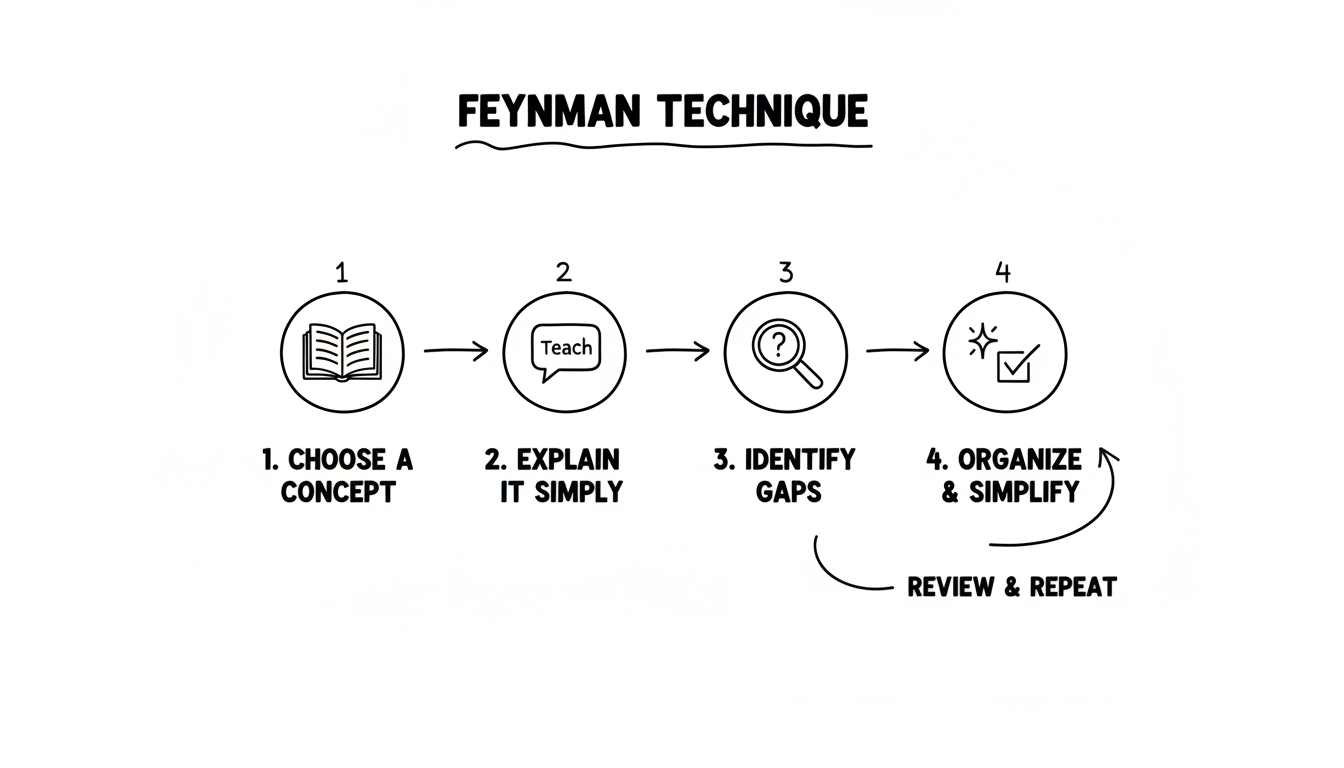
It’s a loop: explain → find gaps → repair → explain again.
Step 1: Pick a concept (small enough)
Choose a single concept — not a whole chapter.
Bad: “Microeconomics”
Good:
- “What does price elasticity mean?”
- “Why does the derivative represent change?”
- “What is backpropagation doing in one sentence?”
If it takes more than ~20 minutes to explain, your topic is probably too broad.
Step 2: Explain it to a 12‑year‑old
Write or speak your explanation as if the listener has zero context. Use short sentences. Use “because”. Use one concrete example.
Step 3: Mark the gaps
You’ll notice moments where you:
- stall (“uh… kind of…”),
- hide behind jargon,
- skip a step without realizing.
Mark those spots. Those are the highest-value minutes of studying.
Step 4: Repair, simplify, test
Go back to your lecture notes/book — but only to fix the exact gap. Then rewrite your explanation:
- shorter,
- clearer,
- with a better analogy,
- with fewer “fake-understanding” words.
Finally, test yourself by explaining it out loud without notes.
When your explanation is good, store it as a mini-lesson:
- 5–10 bullet points,
- 1 example,
- 3 common pitfalls.
This becomes perfect material for flashcards and spaced repetition later.
Examples: what a “simple explanation” really looks like
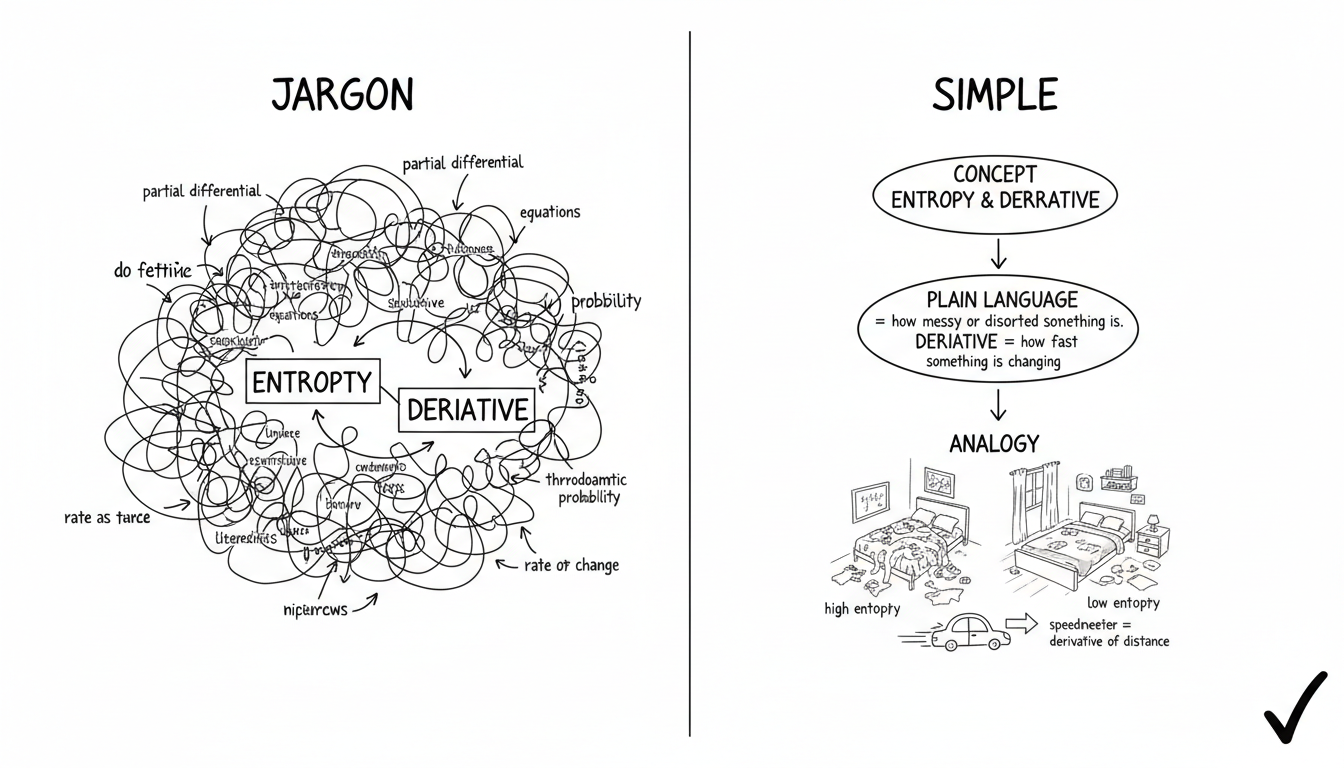
Simple doesn’t mean shallow — it means clear.
Example 1 (math): derivative
Jargon: “The derivative is the limit of the difference quotient.”
Feynman-style: “A derivative tells you how fast something is changing right now. If distance is ‘how far you’ve gone’, then the derivative is your speedometer: it tells you how fast the distance is changing at that exact moment.”
Example 2 (law/social science): causal claim
Jargon: “Correlation does not imply causation.”
Feynman-style: “Two things can change together without one causing the other. Ice cream sales and drowning both rise in summer — but ice cream doesn’t cause drowning. The hidden cause is temperature.”
Example 3 (bio/medicine): osmosis
Jargon: “Water moves down the osmotic gradient through a semipermeable membrane.”
Feynman-style: “If a wall lets water through but blocks the stuff dissolved in the water, then water will move toward the side with more dissolved stuff — to balance things out. Like people flowing from a crowded room to a less crowded room when you open a door.”
Analogies are bridges, not truth. Always write down where the analogy breaks.
Feynman vs. active recall vs. spaced repetition
The best studying usually isn’t one technique — it’s a stack.
| Tool | Deep understanding | Long-term retention | Setup friction | Best for |
|---|---|---|---|---|
| Feynman techniqueEmpfohlen | Yes | No | low | concepts, mental models, explaining |
| Active recall | Yes | Yes | medium | exam questions, definitions, problem solving |
| Spaced repetition | No | Yes | medium | vocabulary, facts, formulas, durable memory |
A practical combo:
- Use Feynman to build the model.
- Use active recall to pressure-test it.
- Use spaced repetition to keep it alive for weeks.
If you only do Feynman, you may understand but forget. If you only do spaced repetition, you may remember without fully understanding. Together, it’s unfair.
A study workflow that actually fits college life

Make the technique repeatable — not heroic.
Here’s a realistic 45–90 minute workflow after a lecture:
- Sort notes (10 min): identify 3–5 core concepts (the Cornell note-taking method makes this step almost automatic).
- Feynman sheet (15–20 min each): 10–15 sentences, 1 example, 1 “why” sentence.
- Gap list (5 min): mark what you can’t explain.
- Fix gaps (10–20 min): look up only those spots.
- Build retrieval questions (10 min): 5–10 questions per concept.
- Daily review (10–20 min): spaced repetition.
If you want a tool to reduce the friction of “material → questions → review”:
Turn your lecture material into real recall questions
okti helps you create flashcards and practice questions from PDFs and slides — perfect for converting Feynman explanations into active recall + spaced repetition.
try okti for freeAI + Feynman: use chatgpt without fooling yourself
AI can amplify the Feynman technique — or push you back into passive consumption. A simple rule:
- AI can provide feedback.
- AI can generate test questions.
- AI should not do the explaining instead of you.
3 helpful prompts (keep you active)
- “Here is my explanation. Where is it unclear or wrong?”
- “Give me 5 tough questions that would expose weak spots.”
- “Give me 2 analogies and tell me where each one breaks.”
(More prompt ideas in our ChatGPT for studying guide.)
3 unhelpful prompts (make you passive)
- “Explain topic X simply.”
- “Write me a summary.”
- “Make me a study guide.”
If you used AI for 10 minutes and didn’t write or speak a single original sentence, it was probably passive.
Template: a great Feynman sheet (copy/paste)
If you want the method to stick, make it a repeatable document. Here’s a structure that forces clarity without taking hours.
Title: “[Concept] in simple words”
- One-sentence definition
- Why it matters (1–2 sentences)
- Mechanism (3–5 sentences)
- One concrete example
- One analogy (optional)
- Where the analogy breaks (important!)
- 3 retrieval questions
- Gap list (“I can’t explain … yet”)
If a first-year student could start a practice problem after reading your sheet, it’s good.
How to adapt the technique by subject
The method is universal, but the shape of a good explanation depends on the subject.
Math / physics / computer science
- Focus: intuition + meaning + when to use it
- Common gap: you can write the formula, but you can’t say what it means
Mini-drills:
- explain each symbol in one sentence
- give one edge case (“when x→0…”)
- name one common mistake
Law / business / economics
- Focus: definition → conditions → consequence
- Common gap: knowing terms without knowing when they apply
Mini-drills:
- write a simple rule (“if A and B, then C”)
- create one case example
- create one counterexample (“doesn’t apply when…”)
Medicine / biology / psychology
- Focus: causal chains (cause → mechanism → effect)
- Common gap: memorizing parts without the chain
Mini-drills:
- draw a 5-arrow chain
- explain every arrow in one sentence
- ask “what happens if step 3 fails?”
Languages
- Focus: meaning + context + production
- Common gap: recognition without production
Mini-drills:
- define the word in your native language
- write 2 original example sentences
- compare to a near-synonym
7‑day plan: build the habit
Day 1: Setup (20 minutes)
- Pick 3 concepts from this week.
- Create one note called “Feynman sheets”.
Day 2: Write 1 sheet
- One concept → 10–15 sentences → mark gaps.
Day 3: Fix gaps + rewrite
- Study only the gaps.
- Rewrite 30% shorter.
Day 4: Explain out loud
- 3-minute mini-lecture without notes.
- Stumbling = new gap.
Day 5: Build exam-style questions
- Create 10 retrieval questions.
- Convert them into flashcards if possible.
Day 6: Review (spaced repetition)
- 15–20 minutes review.
- Explain one concept again.
Day 7: Transfer test
- Solve 1–2 practice problems/past exam questions.
- If you fail: trace it back to a missing concept.
Common mistakes (and instant fixes)
-
Picking topics that are too big
- Fix: one definition, one mechanism, one theorem — not a chapter.
-
Thinking “simple” means “short”
- Fix: structure: definition → example → why it matters.
-
Using jargon as a crutch
- Fix: every technical term gets a one-sentence definition.
-
Never testing yourself
- Fix: write at least 3 active-recall questions per sheet.
-
No repetition
- Fix: 10 minutes per day beats 2 hours once.
If you only do one thing today
Write one Feynman sheet: 15 sentences, 1 example, 3 recall questions. Then review it tomorrow.
go to okti (free)When the Feynman technique is not the best tool
It’s powerful, but it’s not magic. Here are situations where you should pair it with other approaches:
- Pure memorization (anatomy terms, vocab, dates): use spaced repetition as the backbone.
- Skill execution (coding, math proofs, lab work): you still need deliberate practice and problem sets.
- Time-critical cram sessions: use Feynman for the 20% of concepts that unlock many problems; don’t try to “Feynman everything”.
A good rule:
- If a topic has structure and causality, Feynman shines.
- If it’s mostly lists and labels, use spaced repetition.
FAQ
Do I need to teach a real person?
Not necessarily, but explaining out loud is much better than doing it in your head. If you’re alone, teach an imaginary student or record a quick voice note.
Is the Feynman technique good for memorization?
It’s best for understanding. For durable memory, add active recall + spaced repetition.
How long should one “Feynman sheet” take?
15–25 minutes per concept is realistic. If it’s longer, your concept is probably too broad.
How does okti fit into this?
okti doesn’t replace thinking. But it can reduce the friction of turning your material into retrieval questions and flashcards — which helps you keep your Feynman explanations alive via repetition.
Two okti features fit the Feynman technique especially well: in study sessions you can speak your answers instead of typing — okti transcribes them and gives AI feedback on what was missing — which is essentially a Feynman check on demand. And the Tutor mode works like the “imaginary student” in reverse: it asks follow-up questions about your goal, builds a personalized path of interactive lessons, and can explain any text you highlight.
How do I know my explanation is “simple enough”?
Use a concrete audience (12-year-old, first-year student) and check:
- Did you include a real example?
- Did you define every technical term you used?
- Could someone start a basic practice problem after your explanation?
If the answer is “no”, you have a clear next iteration.
Can I do the Feynman technique in a study group?
Yes — it’s one of the best group-study formats. Rotate roles:
- Person A explains (no notes)
- Person B asks “why?” until it gets uncomfortable
- Person C tries to find a counterexample or edge case
Should I do Feynman before or after practice problems?
Both. A pragmatic approach:
- Before: to build the mental model.
- After: to explain your mistakes and fix the missing concept.
Does it work when I’m short on time?
Yes, if you make the topic small. Five minutes of Feynman on one micro-concept beats 30 minutes of passive rereading.
Conclusion
The Feynman technique is an anti-bullshit detector for “I understand this.” It turns vague familiarity into real explanatory power.
Combine it with active recall and spaced repetition, and you get a study system that works for exams and long-term competence.
Next step (small and doable): Pick one tiny concept from your current week and write a Feynman sheet today.
Ready to study with real retrieval?
Try okti for free and create practice questions from your lecture material — so you actually recall what you learn.
try okti for free