Exam Prep in 1 Week: A 7-Day Study Plan (Daily Schedule, Checklist, Methods)
Only 7 days left until your exam? This one-week study plan shows how to prioritize in 60 minutes, use active recall + spaced repetition, avoid common mistakes, and execute a realistic daily schedule — plus a simple checklist.
Exam Prep in 1 Week: A 7-Day Study Plan (Daily Schedule, Checklist, Methods)

With only one week left, you don’t need the perfect study plan. You need a plan that produces points, reduces stress, and tells you every day: What do I do today — and why?
Here’s the key mindset shift: In 7 days you can’t rebuild an entire course from scratch. But you can still make a big jump if you focus on what exams actually reward:
- retrieval / active recall (pulling knowledge out, not reading it in)
- practice problems and common question types
- repetition (so it’s still there on exam day)
- sleep + energy management (otherwise everything collapses)
This guide gives you a practical 7‑day study plan, a fast prioritization method, and a daily checklist.
Table of contents
- The 7-day goal: save points, not “learn everything”
- 3 principles that decide your one-week plan
- Step 1 (60 minutes): prioritize with a simple 3×3 matrix
- Step 2: a daily structure you can actually execute
- Step 3: the 7-day plan (day 1 to day 7)
- Infographic: the 7-day flow at a glance
- Active recall: what to do instead of rereading
- Spaced repetition in 7 days: a minimal version
- Quick comparison: study methods that work in one week (and those that don’t)
- Daily checklist: 10 minutes that protects your score
- Common last-minute mistakes
- Tools: how okti saves time in one-week prep
- FAQ
- Conclusion
The 7-day goal: save points, not “learn everything”
If you try to go through the entire syllabus linearly, you’ll usually end up here:
- You start at chapter 1 and reach chapter 3 on day 5.
- You do lots of “input” (reading, videos) but little “output” (solving, explaining).
- You feel busy — but the exam asks tasks you never trained.
A good one-week plan optimizes for:
- exam-like tasks (what actually appears)
- repeated retrieval (so you can recall it under pressure)
- an error list (so you don’t repeat the same mistakes)
In 7 days, your score depends less on what you consume and more on how often you retrieve and apply the right things.
3 principles that decide your one-week plan
Principle 1: plan 70%, keep 30% buffer
In a stressful week, something always happens: low energy, confusion, bad mood, life. If your schedule is 100% full, it breaks on the first bad day.
Rule of thumb: schedule only 70% of your realistic time. Keep 30% buffer.
Principle 2: output first
One week before the exam, “input” is just support. Your focus is:
- solving problems with solution checks
- answering questions without notes
- explaining concepts out loud
- running short timed simulations
Principle 3: repetition is not optional
If repetition isn’t scheduled, it won’t happen. In 7 days, aim for:
- a short review the next day (10–20 minutes)
- at least 1–2 deeper reviews in the week (e.g. day 4 and day 6)
- a light final review the day before
Step 1 (60 minutes): prioritize with a simple 3×3 matrix
You need a prioritization system that’s fast and honest.
1) create topic blocks (10–20)
Turn your material (slides, notes, syllabus) into blocks you can complete in 1–3 sessions.
Examples:
- “key definitions + examples (chapter 2)”
- “typical problem set: derivatives/integrals”
- “model X: assumptions, steps, limitations”
2) score each block (1–3)
Give each block three scores:
- exam frequency (1 = rare, 3 = likely)
- your confidence (1 = strong, 3 = shaky)
- point impact (1 = small points, 3 = big impact)
Add them: score = frequency + shakiness + impact.
3) decide A / B / C
- A (must): score 8–9 → trained multiple times
- B (should): score 6–7 → at least once + quick review
- C (nice): score ≤ 5 → only if time remains
In a statistics exam:
- hypothesis tests (3+3+3) = 9 → A
- confidence intervals (3+2+2) = 7 → B
- proving a formula (1+3+1) = 5 → C
Result: you drill hypothesis tests on days 2, 4, and 6 instead of spending day 5 rereading chapter 1.
Step 2: a daily structure you can actually execute
In one-week prep you need routine. Otherwise you spend energy deciding what to do, not doing it.
Recommended daily structure
- warm-up (15–25 min): review (questions/cards/error list)
- main block (60–120 min): output (problems, exam tasks, explanations)
- micro input (20–40 min): only what you need for the output
- second block (45–90 min): output again
- 10-minute shutdown: update error list + decide tomorrow’s first block
If you’re short on time, do the minimum:
- 20 minutes review
- 60–90 minutes output
If focus is your weak spot, run the blocks with the Pomodoro technique.
“I’ll summarize first, then I’ll practice.” In one-week prep this often becomes procrastination with a nice layout.
Step 3: the 7-day plan (day 1 to day 7)
Assumption: your exam is on day 8 (or after day 7). If it’s earlier, cut C-topics first — not repetition.
Day 1: setup + priorities + first A-blocks
Goal: clarity + momentum.
- 60 minutes: build blocks + A/B/C
- 90 minutes: A-block #1 (output-heavy)
- 60 minutes: A-block #2
- 10 minutes: start an error list
Output ideas:
- answer 20 questions without notes
- solve 8–15 typical problems
- record 2-minute explanations as voice notes
Day 2: drill A-blocks with feedback
- warm-up: review day 1 (error list + questions)
- main: A-block #1 (new tasks)
- second: A-block #3
- shutdown: update error list
Day 3: add B-blocks + mini simulation
- warm-up: review A-block #2
- main: B-block #1
- second: timed mini simulation (30–60 min)
Day 4: forced repetition day (A-loop)
- warm-up: spaced repetition questions/cards
- main: mixed A-block #1 and #2 (interleaving)
- second: fix the top 1–2 gaps from the error list
Day 5: past paper / big practice set
- 60–120 min: past paper or large task set (timed)
- 30–60 min: analyze mistakes (root causes)
- 45–90 min: targeted drills on recurring errors
Day 6: final A-pass + light B-review
- warm-up: questions/cards (everything still shaky)
- main: A-blocks (short input, lots of output)
- second: key B-block review
Day 7: light review + sleep
- 30–60 min: light review (error list + questions)
- 30–60 min: “exam checklist” (definitions/formulas/strategy)
- stop early: protect sleep
Don’t open brand new chapters. Don’t do 6-hour marathons. You want stable recall, not exhaustion.
Infographic: the 7-day flow at a glance
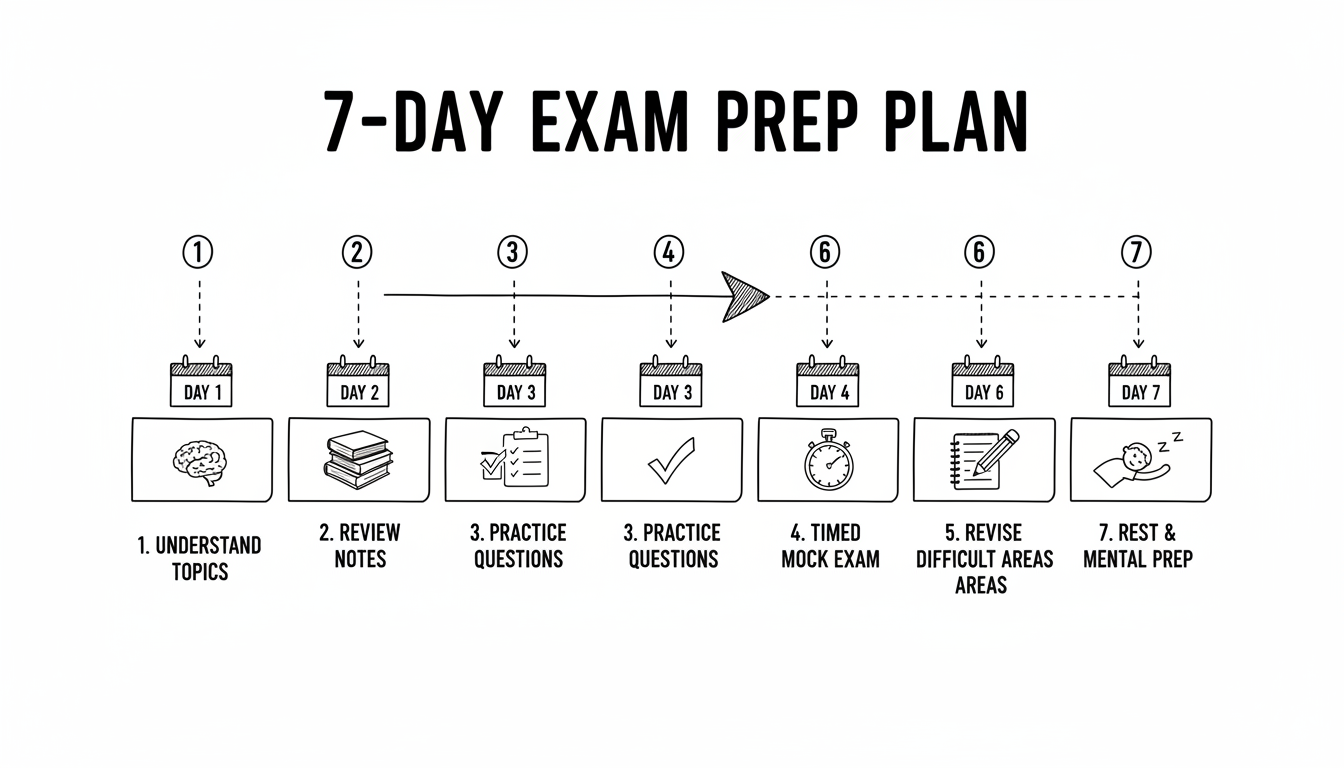
Caption: Setup → A-training → simulation → repetition → final recall.
Active recall: what to do instead of rereading
Active recall forces your brain to retrieve knowledge without help. It feels harder than reading — which is exactly why it works.
High-ROI tasks for one-week prep
- brain dump: write everything you know about topic X for 10 minutes
- question sets: 20–40 questions without notes
- problem solving: with time limits + solution checks
- teach it: explain out loud in 2 minutes
- mini tests: 15 minutes, then correct
Low-ROI tasks (time sinks)
- endless highlighting
- “one more read-through”
- polishing summaries instead of testing yourself
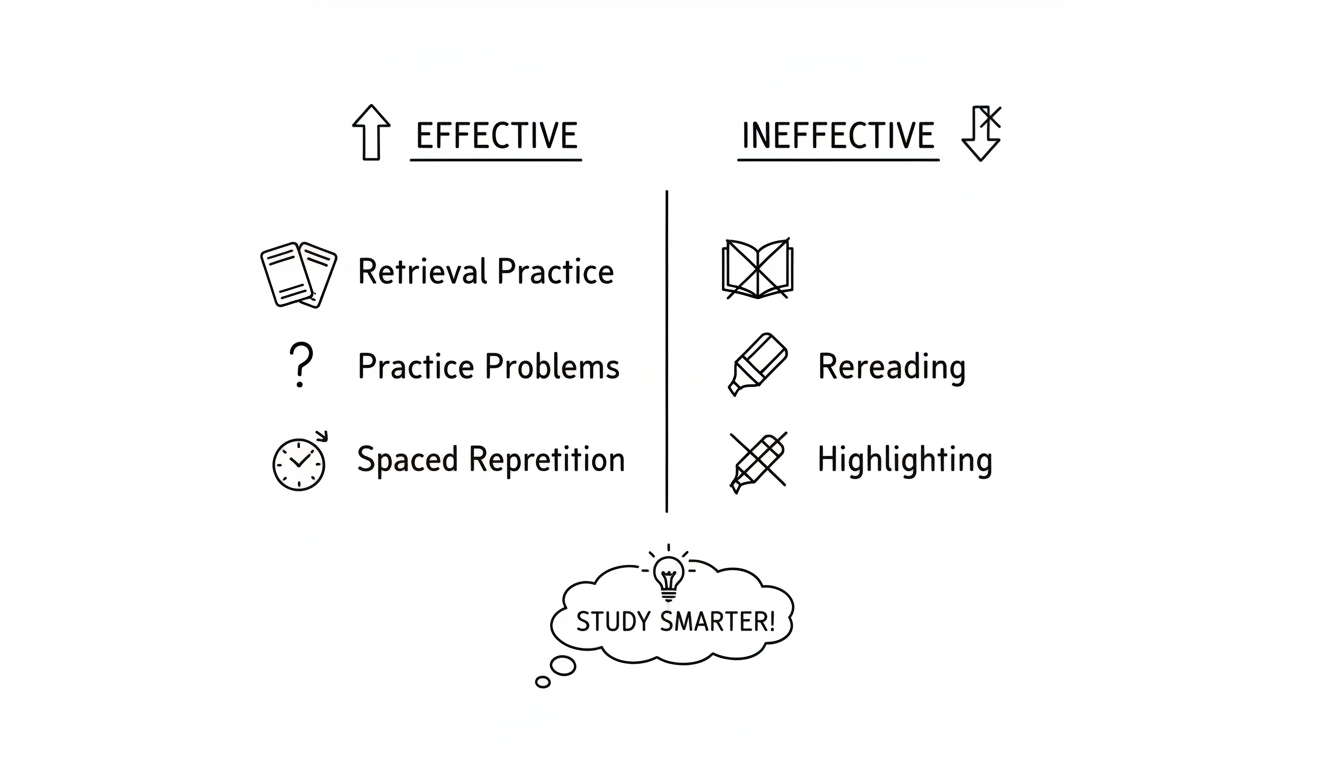
Caption: In the last week, output (retrieval/practice) tends to beat pure input.
Spaced repetition in 7 days: a minimal version
You don’t have time for perfect spaced repetition intervals. But you can still use the core idea:
- day +1: quick review
- day +3/4: second review
- day +6: third review
- day 7: light stabilization
Practical implementation:
- keep a “shaky list” (10–30 items)
- review it every morning
- remove items you can retrieve correctly twice
Turn your materials into repeatable questions
With okti you can quickly generate questions and flashcards from PDFs and slides — perfect for one-week repetition.
try okti for freeQuick comparison: study methods that work in one week (and those that don’t)
| Tool | Improves score? | Fast to execute? | Gives feedback? | Reduces stress? |
|---|---|---|---|---|
| Practice problems + solutions | Very | Yes | Very | Yes |
| Past paper (timed) | Very | Medium | Very | Yes (after review) |
| Active recall questions | High | Yes | High | Yes |
| Spaced repetitionEmpfohlen | High | Yes | High | Yes |
| Rereading/highlighting | Low | Yes | No | Short-term |
Daily checklist: 10 minutes that protects your score
This is your stability anchor. Even if your day collapses, do this:
- read your error list (top 3 mistakes)
- retrieve 10 questions (no notes)
- one tiny output (one problem or a 2-minute explanation)
- decide tomorrow’s first output block
Only do the first step: open the problem set and solve one question. Starting is often the hardest part.
Common last-minute mistakes
Mistake 1: treating everything as equally important
Fix: A/B/C and train A multiple times.
Mistake 2: no solution checks
Fix: every task needs feedback.
Mistake 3: sacrificing sleep
Fix: sleep is part of the plan. After day 5: stopping earlier often beats “one more hour”.
Mistake 4: input overload
Fix: keep input short and immediately convert it into output.
Mistake 5: skipping repetition
Fix: 15–25 minutes every morning.
Tools: how okti saves time in one-week prep
In one-week prep your bottleneck isn’t willpower. It’s how fast you can turn material into trainable units:
- slides → questions
- PDFs → flashcards
- notes → mini tests
A simple workflow:
- upload slides/PDFs
- generate questions/flashcards
- review for 20 minutes daily
- after each practice session, add your mistakes and create targeted questions
Two features help a lot under time pressure: every generated card keeps a “View source” link to the exact page of your PDF, and the Explain button on every card or quiz question explains the answer in simple words — so checking a shaky answer takes seconds instead of a search through your slides. And if an A-topic still doesn’t click, okti’s Tutor mode can explain it in a short personalized lesson.
7 days, 20 minutes per day — realistic and repeatable
okti helps you stay consistent with repetition instead of drowning in chaotic notes.
go to oktiFAQ
Can you still pass an exam with only 1 week left?
Often yes — if you set the right goal: make A-topics solid, practice exam-like tasks, and repeat daily. If you try to relearn everything linearly, your odds drop.
How many hours per day should you study?
Depends on the exam and your starting point. Many students can sustain 2–4 net hours per day in an intense week. Output + feedback + repetition matter more than raw hours.
Should you start new topics on day 7?
Usually no. Exceptions: tiny gaps with clear point impact. Day 7 is for stabilization, not new chaos.
What if you realize an A-topic is completely missing?
Make it an A-topic and cut two C-topics. Focus beats completeness in a one-week sprint.
Conclusion
One-week exam prep is doable if you do the right things:
- prioritize (A/B/C)
- train output (problems, questions, explanations)
- repeat (every morning + day 4/6)
- protect sleep
If you want a faster path from PDFs/slides to repeatable questions, okti is built for that workflow. For more structure, see how to create a study plan and avoiding cramming.