StuDocu Alternative 2026: 9 Legal & Free Ways to Get Study Notes, Summaries, and Flashcards
Looking for a StuDocu alternative? Here are 9 legal options (free & affordable) — from university libraries and course platforms to AI study workflows with okti. Includes comparison tables, pros/cons, pricing, and FAQ.
StuDocu Alternative 2026: 9 Legal & Free Ways to Get Study Notes, Summaries, and Flashcards

StuDocu can be useful when you need quick access to notes, summaries, or past exam materials. But many students run into the same problems: paywalls, inconsistent quality, and the awkward question that never fully goes away — is this material reliable, up-to-date, and copyright-safe?
The good news: in 2026 you have more (and better) alternatives than ever. Some are community-driven like StuDocu, others are official sources (library and course platforms), and the most effective option is often a workflow: use your own course PDFs and convert them into summaries + flashcards you can actually retain.
In this guide you’ll get:
- a practical, student-friendly approach to legality and quality
- a quick comparison table
- the 9 best StuDocu alternatives (free or fairly priced)
- feature + pricing comparisons
- a step-by-step workflow to turn lecture PDFs into a study system with okti
Table of Contents
- When should you look for a StuDocu alternative?
- Quick Comparison: 9 Best StuDocu Alternatives (2026)
- The 3 criteria: legality, quality, time saved
- 1. okti — turn your PDFs into summaries + flashcards in minutes
- 2. Studydrive — community notes with strong EU presence
- 3. Docsity — international study materials
- 4. University + public libraries (incl. eResources) — underrated
- 5. Official course platforms (Moodle/Canvas/Blackboard) — the source of truth
- 6. Notebro — lightweight note sharing (varies by school)
- 7. YouTube + lecture recordings + okti — turn videos into flashcards
- 8. Study groups, student unions, internal exam pools
- 9. Tutorials, problem sets, and solutions — closest to the exam
- Feature comparison
- Pricing comparison
- FAQ
- Conclusion: what’s the best StuDocu alternative in 2026?
When should you look for a StuDocu alternative?
A StuDocu alternative is worth it if any of these apply:
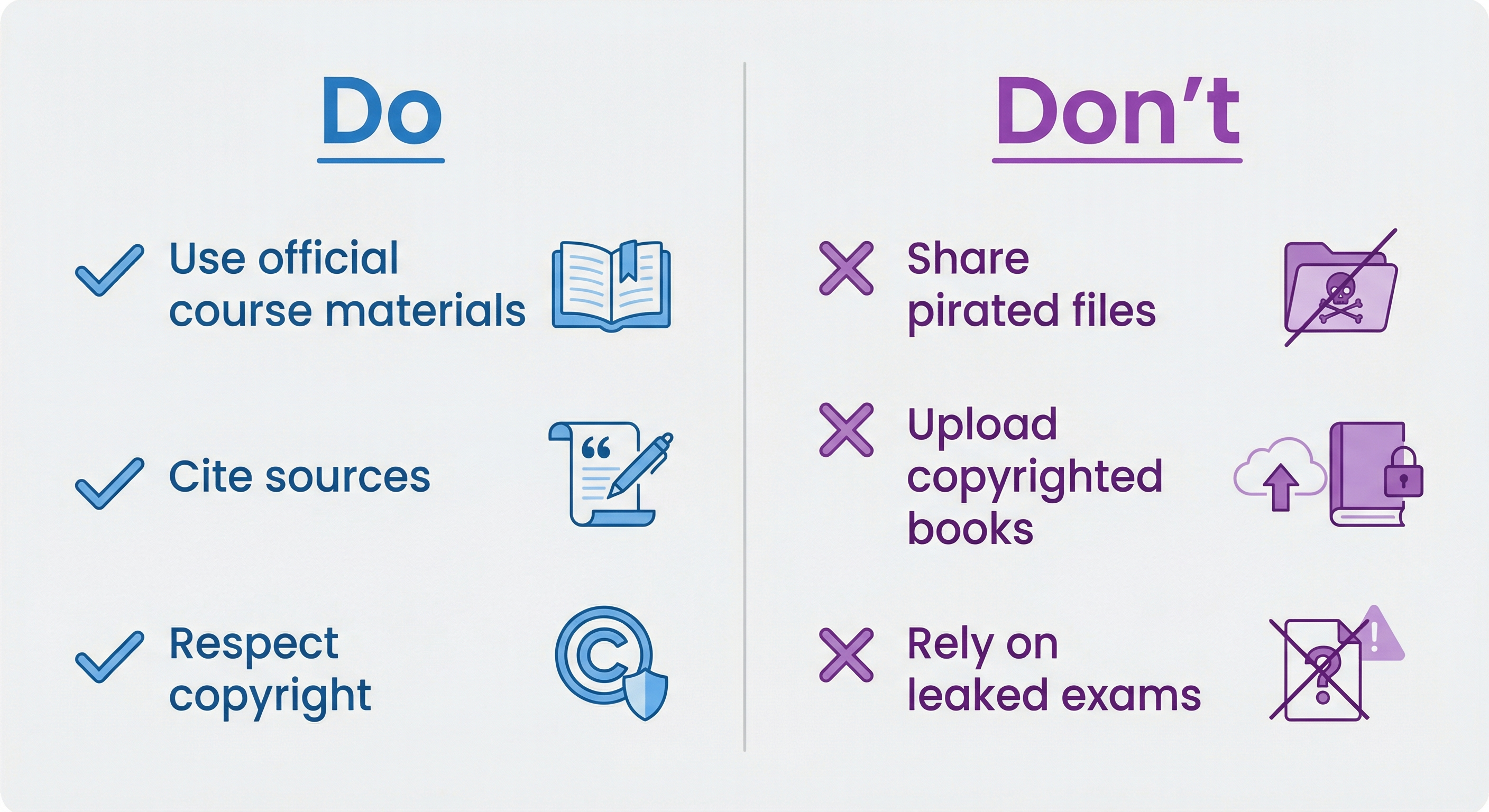
- You want copyright-safe materials (especially for textbook scans and protected scripts).
- You want consistent quality (community uploads are hit or miss).
- You want to study faster — not just collect documents.
If you find yourself spending more time searching, unlocking, and evaluating documents than actually learning, you’re paying a hidden cost: attention and time.
Quick Comparison: 9 Best StuDocu Alternatives (2026)
| Tool | Free to use | Quality/structure | Copyright safety | AI summaries | AI flashcards |
|---|---|---|---|---|---|
| oktiEmpfohlen | Yes | high | high | Yes | Yes |
| Studydrive | Yes | medium | medium | No | No |
| Docsity | Yes | medium | medium | No | No |
| University library | Yes | high | high | No | No |
| Course platform | Yes | high | high | No | No |
| Notebro | Yes | medium | medium | No | No |
| Study groups | Yes | medium | high | No | No |
| Problem sets | Yes | high | high | No | No |
| YouTube + okti | Yes | high | high | Yes | Yes |
The best StuDocu alternative is often not a single website. It’s a workflow: official materials (legal) + AI conversion (fast) + spaced repetition (retention).
The 3 criteria: legality, quality, time saved
1) Legality / copyright safety
StuDocu-style platforms depend on uploads. That means you can’t always know whether a document is a professor’s copyrighted script, a textbook scan, or a properly shared student summary. Even if platforms remove content, the gray zone is real.
A safer approach is to base your studying on:
- official course documents
- library resources
- your own notes
2) Quality / fit to your course
A “great” summary is useless if it doesn’t match your lecturer’s scope, notation, or exam emphasis. Your own course PDFs are usually the highest-signal input.
3) Time saved
You don’t need more files. You need learnable outputs:
- a clear outline
- concise summaries
- flashcards (one idea per card)
- practice questions
- a review schedule
1. okti — turn your PDFs into summaries + flashcards in minutes
If you use StuDocu mainly for ready-made summaries, okti is the alternative that tends to save the most time — because you stop searching and start converting.
Upload what is actually exam-relevant:
- lecture slides
- official scripts
- your class notes
- problem sets + solutions
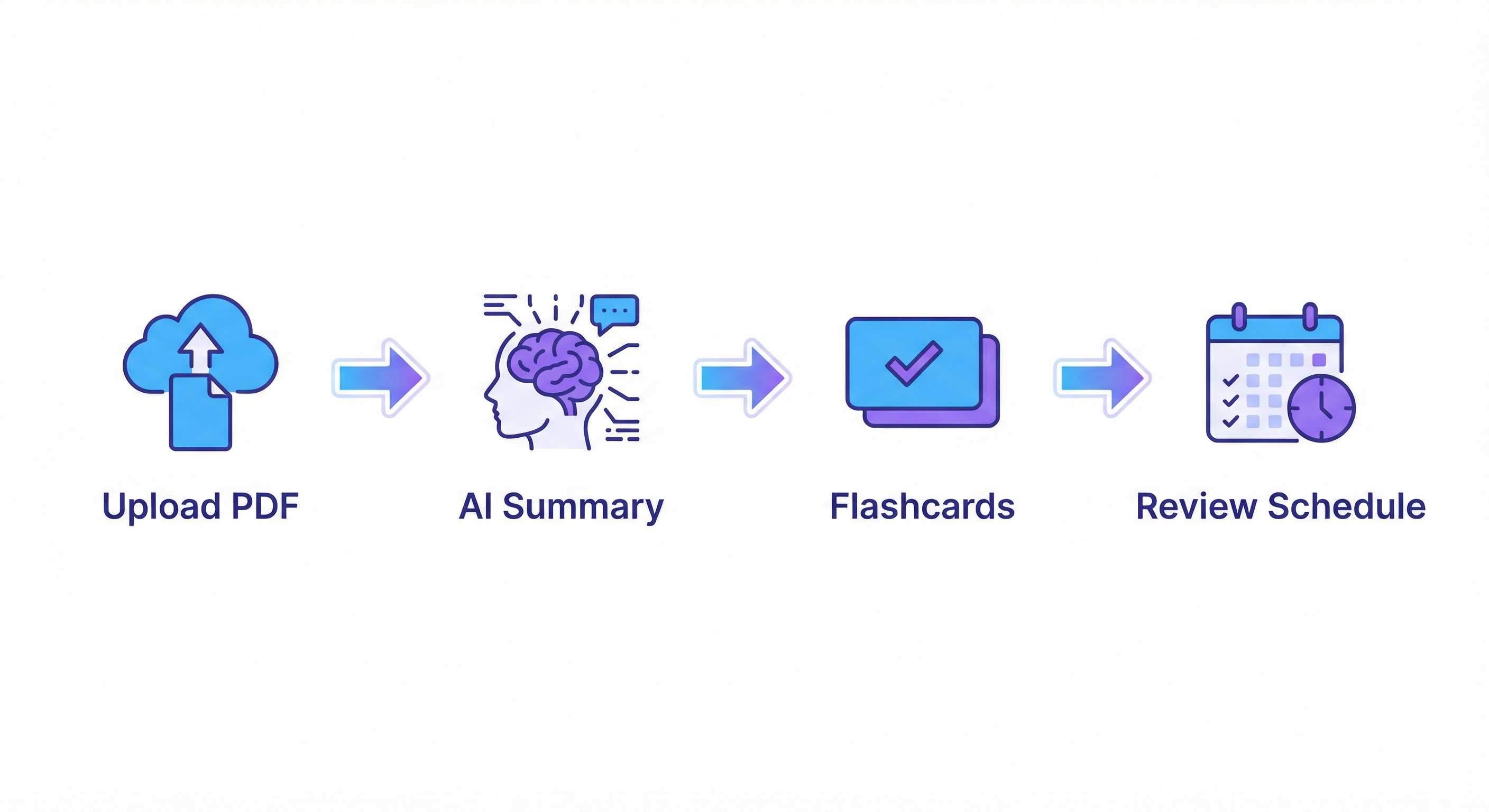
Then okti helps you generate:
- structured AI summaries
- flashcards (definitions, formulas, cloze cards, Q/A)
- a study flow built around spaced repetition
Two newer features make okti even stronger as a StuDocu replacement: the AI Chat (beta) answers questions grounded in your own documents, notes, and decks — and can create flashcards, quizzes, or notes straight from the conversation (you approve every change). And the Tutor mode turns a learning goal into a personalized path of interactive lessons, so you’re not just collecting documents but following a plan.
Pros
- Very fast: turn 30–80 pages into a study-ready system
- Your materials = your course → better fit
- Builds durable knowledge, not just downloads
Cons
- You need your own course PDFs (which is usually a good thing)
- Output quality depends on input quality (clean, readable PDFs work best)
Turn lecture PDFs into flashcards in minutes
Try okti for free: upload a PDF and generate a summary + flashcards you can review with spaced repetition.
Try okti free2. Studydrive — community notes with strong EU presence
Studydrive is one of the best-known community platforms in Europe. It can be a helpful supplement if your university and modules are well represented.
Pros
- often strong coverage for many EU programs
- plenty of summaries and shared notes
- usually a free entry point
Cons
- quality varies a lot
- upload/unlock mechanics
- documents may not match your specific course
3. Docsity — international study materials
Docsity is more internationally oriented. It can be useful for common subjects (business, engineering, medicine) or if your materials are in English.
Pros
- broad international library
- useful for standard topics across universities
Cons
- less specific to your lecturer/exam
- same community-upload uncertainty
4. University + public libraries (incl. eResources) — underrated
If you want a legal StuDocu alternative, the library is often the highest-quality option — and many students barely use it.
Libraries can give you:
- textbooks (print + eBooks)
- research databases (varies by institution)
- course reserves / reading lists
- sometimes official past exams
Practical tip: search by course name, module code, or lecturer — not just book titles.
Then export relevant chapters/pages (where allowed) and convert them into flashcards and summaries with okti.
5. Official course platforms (Moodle/Canvas/Blackboard) — the source of truth
For exam relevance, official platforms win:
- lecture slides
- problem sets
- solution sheets
- announcements (“this will be on the exam”)
- forum clarifications
Many students go to StuDocu because their LMS feels messy. The better move: download weekly, organize by topic, then convert into study formats.
Once a week: download new PDFs from your course platform, put them in a folder, and let okti generate chapter summaries + flashcards.
6. Notebro — lightweight note sharing (varies by school)
Notebro is a simpler note-sharing site. Coverage varies a lot by university, but when it’s good, it’s a solid free option.
Pros
- low friction
- often free access
Cons
- uneven coverage
- limited structure and quality control
7. YouTube + lecture recordings + okti — turn videos into flashcards
Many courses now include recorded lectures, YouTube playlists, or tutorial videos. Great for understanding — but hard to retain.
A useful approach is to extract the key ideas (via transcripts/notes) and convert them into:
- definitions
- concept comparisons
- typical exam questions
That’s where okti is helpful: you turn video learning into a spaced-repetition system. We wrote a full guide on how to create flashcards from YouTube videos.
8. Study groups, student unions, internal exam pools
The most underrated StuDocu alternative is: people.
- student union archives
- course Discord/WhatsApp groups
- internal past exam collections
This is often closer to your specific exam style than random online uploads — and can be cleaner legally when shared within the course context.
9. Tutorials, problem sets, and solutions — closest to the exam
If you prioritize just one thing, prioritize this: problem sets + solutions.
Most exams test application and problem-solving. Turn solutions into flashcards like:
- “What’s the first step in solving X?”
- “Which formula applies when Y?”
- “Common mistakes in problem type Z?”
Feature comparison
Search & organization
- Community platforms: lots of documents, noisy search
- Official platforms: structured, but not optimized for review
- okti: converts what you already have into a study format (summary + flashcards)
Study output vs file output
- StuDocu-like sites deliver files
- okti delivers a learning system (review schedule + flashcards)
Privacy & friction
Many platforms require accounts, upsells, and tracking. If that matters, rely more on official sources and create your own study pipeline.
Pricing comparison
Prices change frequently. Focus on the pricing model:
- Truly free: library, course platform, study groups, tutorials/problem sets
- Freemium: Studydrive, Docsity, Notebro (often with unlock mechanics)
- Subscription-heavy: many “unlock” platforms
- Time-saving approach: okti reduces searching/unlocking by converting your course PDFs into summaries + flashcards
You don’t need 20 downloads — you need 20 great flashcards
Use okti to generate flashcards from your course PDFs and review them with spaced repetition.
Go to oktiPractical guide: build a study system in 45 minutes (without endless StuDocu scrolling)
If you want to start today, here’s a workflow that works for most courses:
-
Collect input (10 min)
- Download the last 2–4 weeks of lecture slides and problem sets from your LMS.
- Rename files clearly (e.g.,
W03-Regression.pdf).
-
Mark exam relevance (5 min)
- Check announcements, tutorial sheets, and any “sample exam” hints.
- Highlight topics that show up repeatedly (those are usually exam hotspots).
-
Generate summaries (10 min)
- Upload the PDFs to okti.
- Create one summary per topic/chapter (small and focused beats one giant document).
-
Generate flashcards (10 min)
- Let okti draft flashcards.
- Do a quick human pass: keep the 10–20 highest-signal cards per chapter.
-
Start spaced repetition immediately (10 min)
- Review daily for 15–25 minutes.
- This beats cramming because retention compounds over time.
If you use documents from community platforms, treat them as hints. Always cross-check definitions, formulas, and examples against official course materials.
Quality checklist: how to spot good study materials
Whether it’s from a community site or a study group, this checklist saves you time:
- Does it match your syllabus? Same topic order, notation, and scope.
- Are references clear? Best case: slide numbers or chapter links.
- Is it exam-oriented? Includes typical problem types, definitions, and pitfalls.
- Is it up to date? Courses change more often than students expect.
- Is it learnable? Clear structure, examples, and actionable cards — not just long text.
Which alternative fits your goal? (fast decision guide)
People search for “the best StuDocu alternative”, but the best choice depends on what you’re trying to achieve:
- I want the official, complete material: university library + course platform.
- I want exam-style practice: problem sets, tutorials, student union resources.
- I want explanations that click: study groups, tutorial videos, then convert into flashcards.
- I want maximum retention with minimal time: okti + spaced repetition.
- AI summaries from your PDFs
- AI flashcards + review flow
- Fits your syllabus (your input)
- Official sources
- High reliability
- Most exam-relevant
- Large community library
- Quality varies
- Not always syllabus-specific
FAQ
1) Is StuDocu legal?
It depends on the specific document. With community uploads, you can’t always verify copyright status. For most students, the safer baseline is official materials + library resources + your own notes.
2) What is the best free StuDocu alternative?
For reliable and legal access: your university library + your course platform. For converting those materials into a study system: okti.
3) What should I use if I need a summary quickly?
If you have the course PDFs, okti is usually the fastest: generate a structured summary and then flashcards for retention.
4) What’s best for past exams?
Official past exam repositories (when available), student union collections, and tutorial sheets are typically the most aligned with your course.
5) How do I make good flashcards from lecture slides?
Keep one idea per card, use clear prompts, include examples, and review with spaced repetition. okti automates the heavy lifting by extracting key concepts and drafting cards from your PDFs.
6) Are community platforms still worth using?
Yes — as a supplement (examples, alternative explanations). But don’t build your whole study plan on documents that may not match your syllabus.
Conclusion: what’s the best StuDocu alternative in 2026?
If your goal is to study legally, efficiently, and in a way that actually sticks, the best option is usually a combination:
- official course materials (LMS) + library resources
- problem sets and tutorials for exam proximity
- okti to turn those inputs into summaries + flashcards + a review flow
Community platforms like Studydrive or Docsity can help you fill gaps, but your most reliable advantage is converting your own course content into a retention-first system.
Ready to turn your course into a study system?
Start with one PDF — okti generates a summary + flashcards and helps you review effectively.
Start okti